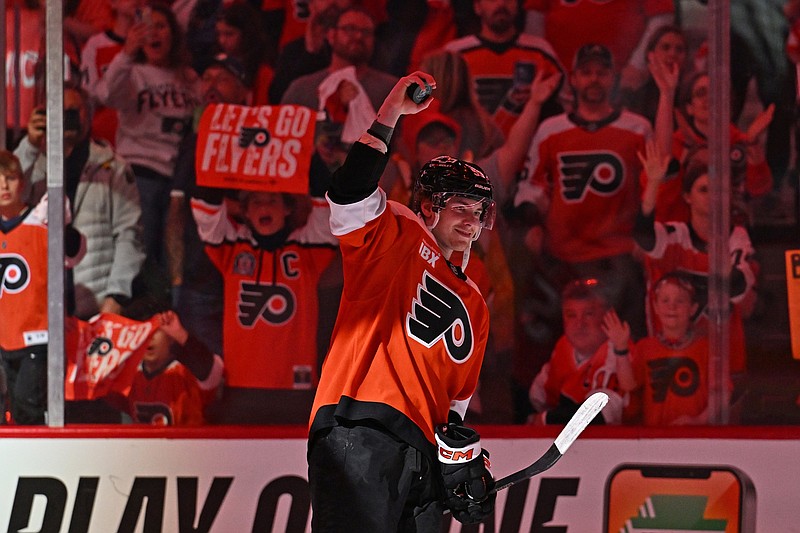
Apr 14, 2026; Philadelphia, Pennsylvania, USA; Philadelphia Flyers defenseman Oliver Bonk (59) acknowledges the crowd after being named second star of the game against the Montreal Canadiens at Xfinity Mobile Arena. Mandatory Credit: Eric Hartline-Imagn Images
PHILADELPHIA — There is a word used in sports that is incredibly polarizing, yet it shouldn't be.
Still, if I had a nickel for every time it was mocked, derided, scoffed at or spoken of derogatorily, I'd buy my own sports franchise and the first thing I'd try to do is establish it.
The "it" I'm talking about, is culture.
A taboo word to some, culture matters in sports, never mind in business or in life. It is a foundational piece that is needed to build success.
Choosing to get angry about your sports teams who espouse wanting to build a strong, positive culture for their players is energy wasted.
Name one successful sports franchise who doesn't have a good culture. Name one where things are run haphazardly or where there is constant drama, or where the rules apply to some but not all, or only apply sometimes.
It's all right if you can't think of one. I don't want you to expend even more wasted energy than you already have.
And you don't have to look far to find examples where it has mattered.
The Eagles built a winning culture under first, Jeff Lurie, second, Howie Roseman, and third a series of coaches that have led to two championships and being a perennial contender for the better part of three decades.
On a shorter time scale, and less ultimate success, the Phillies went from being a laughing stock to an annual contender once they brought in Dave Dombrowski to be the adult in the room to fix how things were being done from a baseball operations perspective.
You could question some roster decisions he's made (or not made) in recent seasons, but you can never begrudge the overhaul of the organizational practices that he put in place to change the Phillies from being behind the eight ball as compared to other teams in such departments as player development and analytics, to being one of the five or six "haves" in the sport. Part of that was also creating a clubhouse culture of winning that was born out of a combination of togetherness and professionalism.
But it's not just those things. A winning culture is about building camaraderie among players, sure, but also setting a standard of excellence that is an expectation and not just a target.
It takes time, and the height of that standard should slowly rise over that time. You can't set it too high too soon, or you'll never attain it. It needs to be a progression. There need to be checkpoints along the way to save progress. Reaching those checkpoints should be celebrated in small ways, before raising the bar.
It's not easy. But you aren't succeeding as a group without it.
And when it erodes or disappears completely, chaos can ensue and you are left in a very strange and tricky spot, one that could take a decade, if not longer, to escape.
Take the Columbus Blue Jackets as the latest cautionary tale.
On January 12, the Blue Jackets fired their coach Dean Evason and replaced him with veteran bench boss Rick Bowness.
After Bowness arrived, the Blue Jackets were one of the best teams in the NHL for a while. They went 9-1-1 in Bowness' first 11 games leading into the Olympic Break.
A lot of people thought they might cool off because of all the time off, But Bowness had them playing a certain style of defensive hockey that was working, and the Jackets came out of the Olympics going 8-1-4.
One would think that Bowness had established a great culture incredibly quickly if Columbus only lost two of his first 24 games as coach in regulation.
But that's when things got hairy. That's when the pressure started to mount. And that's when he learned a lot about the players in his own locker room.
They would go on to loss 10 of 13 including their last six games on home ice and miss the playoffs.
It culminated with one last loss to the Washington Capitals on Tuesday, in a game that had nothing on the line but pride, and when the Blue Jackets decided to half-ass it through their last official work day, Bowness decided to hold them accountable — publicly.
An emotional and angry Rick Bowness goes OFF on his #CBJ team after their 2-8-1 finish to the season: “These guys, they don’t care. Losing is not important enough to them … If I’m back, we’re changing this freaking culture.” pic.twitter.com/ZjBpaxhmPB
"I don't know if I'm back (as coach next year), but if I'm back I'm changing the culture," Bowness told reporters in his postgame press conference. "These guys don't care. Losing is not important to them. It doesn't bother them. ... This is why we are where we are. This is why we are out of the playoffs. ... You have to hate losing. I don't care if it's a meaningless game. I don't care. Show up and compete."
But why did it go so wrong for 13 games after it was going so right for 24 of them?
"Because it got tough," Bowness said. "Because it got hard. ... Everything is good as long as it's going their way, but now it gets tough and we don't want to battle back. That's what's happened over the last couple weeks. ... Some of those guys are so lucky the season is over and there is no practice tomorrow. ... It's terrible. Inexcusable. If they're not embarrassed, not just by tonight but that (six-game home losing streak) they're on the wrong team. ... The players were told tonight, if I'm back, we're changing this freaking culture."
Why did I spend all this time talking about the Columbus Blue Jackets?
Because the Flyers also played a meaningless game on Tuesday. Not only was the Flyers game meaningless, but they dressed a roster that was more akin to an exhibition game in September.
Some bottom of the lineup veterans. A few rising young players like Tyson Foerster, Matvei Michkov and Porter Martone, a backup goalie and a slew of prospects and minor leaguers.
And you know what they did? They went out and beat a Montreal Canadiens team who needed to win to have a chance secure home ice advantage for their first round playoff series, 4-2.
The best part about it? They looked like they belonged.
Oliver Bonk and Hunter McDonald made their NHL debuts and did so with authority. Bonk had a goal and an assist, becoming the first Flyers defenseman to score a goal in his NHL debut.
McDonald picked up an assist and otherwise was a physical menace on the ice, playing with a nasty, throwback edge to his game.
Three milestones calls for a massive group photo. 🤩 pic.twitter.com/IhavT2INf5
David Jiricek, acquired at the deadline from Minnesota in the Bobby Brink trade, made his Flyers debut and had a solid defensive game.
Alex Bump was back in the lineup, and he scored again. Porter Martone stayed in the lineup and extended his point streak to seven games.
And then there's Michkov, who looks like a different player of late. He was the game's first star and finished with a goal and two assists, but more importantly, he wanted to reach the 20-goal and 50-point plateaus for the season, which he did.
Those milestones, while not particularly impressive totals in general, are still important, considering all the hubbub that surrounded him up until about six weeks ago.
How he finished the season was indicative of how the Flyers have been building their culture — and getting guys to buy into it even when things seem to be at their lowest point.
It was just six weeks ago when the Flyers were trying to manage messaging about Michkov after Tocchet had some harsh words for his mercurial young star at the annual Flyers carnival.
Now, six weeks later, Michkov is playing the best he has all season, pulling on the same rope as the rest of his teammates and reaching mile markers in a season that at one point seemed unreachable.
It's not the sole reason the Flyers are in the playoffs right now. A great team culture can't do that alone. But it's certainly plain to see that it is a part of the team's success.
The Flyers finished the season with 98 points. That's a 22-point improvement from a season ago, and the most since 2017-18 (also 98 points).
They won 43 games. That may not seem like a lot for an 82-game season, but it's something they've only done seven times previously since the advent of the loser point in 1999-00, and not since winning 47 games in 2011-12.
Winning that 43rd game with a roster that had 10 guys on it who spent most of the season in the AHL is also indicative that the culture is organizational, and not just with the NHL club.
Part of that was the institution of coaching systems and strategies being in-line with one another at both the NHL and the AHL level, something that wasn't done when John Tortorella and Ian Laperriere were the respective head coaches.
Rick Tocchet and his coaches worked closely with Phantoms coach Jon Snowden and his staff to ensure that the minor league guys were doing the same thing the NHL guys were doing every day. It would allow for a more seamless transition when those players would be called upon for the big club.
You saw that Tuesday.
"I was a believer, but I didn't know it would lead to this," Comcast-Spectacor Chairman and CEO Dan Hilferty told me on The Press Row Show prior to Tuesday's game. "I bought into the whole idea that we were going to take our time, draft, and we weren't going to make any rash decisions on whether to trade or not trade. I believed in that. For this to come to the point that it has today, is a bit of a surprise to me."
Hilferty said the Flyers reaching the playoffs, while it was a goal, and one the organization wanted the players to try to accomplish, the bigger target in year three was solidifying the culture for the organization so that the Flyers once again became a destination location for players and their families.
"It's a pleasant surprise and for the right reasons," Hilferty said. "This group of players, the coaches, (G.M.) Danny (Briere), (President Keith Jones) — they've just done a remarkable job of building the culture that I've hoped to build."
And if you think it's just a line of bunk, consider what happened after the win that secured the playoff berth for the Flyers on Monday.
The team has handed out a Bernie Parent goalie mask to the player of the game after each victory. The recipient of the mask after the previous win, bestows it upon the next player, and that player gives a brief locker room speech to a round of applause from his teammates.
On Monday, the most recent recipient, captain Sean Couturier, gave the mask to Hilferty, out of appreciation for what the organization has built and the process to making the Flyers matter again.
There was always belief in this building.#CARvsPHI | @IBX pic.twitter.com/D5iCQxbJwW
"I'm not trying to be Ed Snider," Hilferty said about the Flyers legendary founder. "There's only one Ed Snider. But I have my own brand of leadership. I'm not the owner, I represent ownership. I'm very clear about that. When I walk in that locker room, I'm not like Keith, and Danny and Toc, who are evaluating talent and working with these guys. I'm just a guy that represents every fan in this building and what I say is either 'Thank you,' or 'Great game,' or 'We'll get them tomorrow.' And I think a level of trust has been built between the human beings that occupy that room and me as a person who sits in a really neat position to lead this organization.
"When that happened, I was totally shocked that they gave me the Bernie mask, but when I pulled it off, and they said 'Say something,' and I felt really comfortable saying, 'I believe in you guys as human beings and this is really special. You are doing something great not only for this city, not only for yourself not only for the organization but for this city and this organization and it will be remembered forever.'"
It's all part of what the Flyers are building. It's why there is real excitement about hockey in this town for the first time in a decade-and-a-half.
Yes, the Flyers are still flawed. Yes, there are still things they will need to do to improve the team. And yes, there will be a raised bar of expectations going forward and there will certainly be more hurdles. More setbacks. More criticism. More of a harsh spotlight when things go sideways.
They all know that. They all know the road to where they want to get is not paved in gold.
But when times are tough, they now have the foundation that they have built to fall back on and know that it was created with a purpose — and qualifying for the postseason is good evidence that it has the impact leaders insist that it
"Culture is an overused term," Hilferty said. "But I believe in culture. I believe that if you build a culture where people maximize their individual potentials for a common cause, great things happen and I believe we've got this culture in place to build a sustainable position as a competitor for Stanley Cups."